Most RE classrooms now have a computer; access to the internet and a projector. This means that we can now access a wide range of free resources which we can use to engage our students. Both reonline and NATRE / REtoday are good starting points, but the ideas below might prove useful too.
Ideas; links and resources will be added weekly to help inspire you and your students. Feel free to add your own ideas in the comments box which will then be added to the list (and credited)
Good Starting Points
The following websites are good starting points for lesson plans; downloadable videos and other ideas
This site is free to join, and offers lots of downloadable videos plus lesson and assembly plans. The MTV Cribs style tours of places of worship are particularly useful.
Use the menu to search for RE resources by Key Stage. The site includes videos and resources that can be used with interactive whiteboards.
Creating Resources
An amazing free downloadable computer app that can be used on your school computer and displayed onto your interactive whiteboard. Not RE specific, but you can make games such as ‘Find 10’ where students have to select the 10 correct statements from a selection of 15, alongside student selectors; group makers and timers. The basic app is free, but you can download it for the whole school for a small price and for a personal subscription you can store your work ‘in the cloud’ (although everything is savable on your network / laptop)
Tarisa
If you google ‘tarsia’ (or speak to your Maths department if you are in a Secondary school) you will come across a wonderful tool to make a variety of puzzles. The free download allows you to make matching puzzles in the shape of hexagons / pentagons or triangles where students match up key words & definitions or you make dominoes or discussion circles.
MyRebus

Is a new(ish) website that allows you to make picture puzzles from words / phrases. Simply type in your word / question or phrase and it will turn it into a puzzle.
Here is one for the question ‘Which city in Israel would both Christians and Jews visit on pilgrimage?
Popplet (free on the internet, also downloadable as an ipad app)
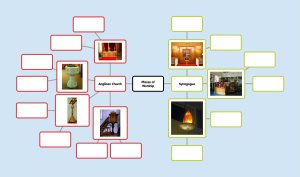
Popplet is a brainstorming website that allows you to make very visual mind maps – these are colourful, simple to look at and can contain images (if you want to print out) of if you show online can include videos too. You can leave ‘popples’ empty for students to write in.
Extending Student Learning through Digital Magazines

Flipboard is a Google Chrome extension / app that allows you to copy articles from websites include newspaper and magazine articles into your own magazine. The Philosophy and Ethics Department at Ridgeway School are currently producing their own magazine for A Level students and it can be found here http://flip.it/jho1C
It is very easy to do. If you need help, then email [email protected] or tweet @hartleyian or catch him at the 3rd Conference and he will explain all!
If you are on twitter, then search out the lively RE community on there. Search for us using #reteacher – lots of relevant links and lesson ideas are posted each day.

Brooke J (2014) The RE Teacher’s Survival Guide: A practical guide to teaching RE in primary schools Abingdon: Bible Reading Fellowship
ISBN 978 0 85746 220 6 £6.99
(Covers the basics although the section on Assessment is already dated)
David Hampshire has drafted two documents to illustrate how Christmas and Easter might be taught in a way that supports progression
Christmas Y1 – Y6 Objectives
Easter Y1-9 Objectives
Teaching Judaism: Some Common Misconceptions by David Hampshire
Judaism: the Essentials by David Hampshire
Gill Tewkesbury won the Hockerill / NATRE prize for innovate teaching in RE for 2014 for her work in primary school. She has kindly shared her Scheme of Work, the details of which are from the Hockerill website
This SOW follows the life of Jim, an 18 year old student who has just finished his A-levels and is planning to work as a Gap year student for a charity in Africa. Each week Jim sends a letter, e-mail or text to the class telling the children what he is doing as well as asking for help and advice. The children follow Jim on his journey as he learns more about the Christian faith. The materials have also been developed to work alongside a geography topic, namely Africa. The materials draw together the Key Stage 2 “Beliefs in Action in the World”, “Sacred Writings” and the “Inspirational People”, parts of the previous curriculum supported by Devon and Exeter Diocese and is easily transferrable to the new scheme looking at “How do we make moral choices?” (Beliefs in Action) and “How should we live?”. It is currently being used for Year 4 children but can be adapted easily for other year groups
The judges commented that this is a creative, innovative way of opening up and applying Christian belief and teaching. The entry makes excellent use of following fictional 18 year old Jim on his Gap year journey and showed very deep learning from religion. Uganda is chosen because there is an excellent link with a local Barnstaple charity working there. In short this entry ticked all the boxes for the judges including transferability to other schools and adaptability to other religions.
ICT in the RE Classroom: An Introduction by Ian Hartley
Making RE Memorable, Meaningful and Motivating:
This year Gill Tewkesbury undertook some funded research as a Farmington Fellow exploring how RE can be memorable, meaningful and motivating.
She concluded that the using the following approaches can help:
RE: Memorable, Meaningful, Motivating… a methodology! her Farmington Fellowship Report 2014-2015 can be read here